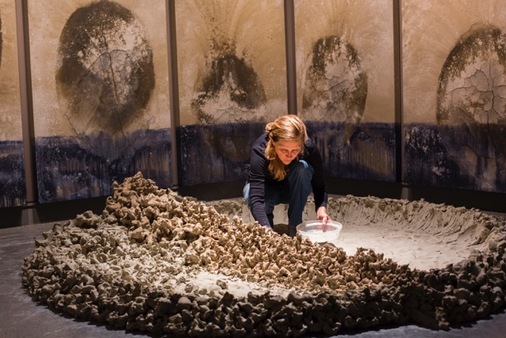
Evaporation Pools
An Evaporation Pool is a process piece that will alter and change for the duration of the exhibition. It begins as a large reflective pool. The clay form will display an exquisite balance of saturation and containment. When the liquid slip is poured into the clay basin, the process of saturation, sedimentation, and the formation of diluvian channels will begin.
The clay particles in the slip will settle to the bottom of the pool. The glassy sheet of clear water above will magnify the subtle activity of the clay settling below, while mirroring light and external images in the surrounding space of the gallery. The phenomenon of the fractal can be immediately observed. Geological occurrences and patterns that take place on a large scale on the surface of the earth, such as alluvial fans, glaciated canyons and submerged stream terraces, are formed in the piece in a repetitive and diminutive scale.
We could be observing the surface of the earth from above, while at the same time, witnessing a deeply internal process within the human body. The human body and the earth are each composed of 70% water; the action of the water within and without the human body and landscape is similar. The intimate connection between both creates an ever-fluid living system of permeability in which water is constantly transpiring. One intention of the pool is to create an opportunity to witness this ‘living process’.
Slowly, over the course of the exhibition, the water in the piece is absorbed into the clay form, while at the same time evaporating into the air in which we breath. By isolating an aspect of a vast water system that has been present throughout the earth’s millennia, I often find myself wondering where this water has transpired before. How many life forms were permeated, and therefore enabled to live, as a result of the passages, upwellings and permutations of this water over time? We as humans, within our nascence float in the amniotic “fruit water” of the womb. How many lungs have been intimately touched by this very water; water that now lies paradoxically still, yet is imperceivably moving within the pool?
Eventually the water will leave the piece, creating an inner plane of fissures, cracks, and newly formed segments. The segment patterns will be varied in both shape and color. Those areas retaining water the longest will display a deeper color, while the driest sections will become lighter. Further in the process, the entire piece will dry out, resulting in a random orderliness of infinite patterns. This last dynamic pattern is a result of the energetic force lines brought about by the movement of water through and away from the structure of the form.
The process of saturation and evaporation within the piece occurs instantly and simultaneously, providing ever changing events as a living process throughout the exhibition. The pool exists as a permeable object, and as such may be viewed as a temporary structure existing within the fluidity of change.
The clay particles in the slip will settle to the bottom of the pool. The glassy sheet of clear water above will magnify the subtle activity of the clay settling below, while mirroring light and external images in the surrounding space of the gallery. The phenomenon of the fractal can be immediately observed. Geological occurrences and patterns that take place on a large scale on the surface of the earth, such as alluvial fans, glaciated canyons and submerged stream terraces, are formed in the piece in a repetitive and diminutive scale.
We could be observing the surface of the earth from above, while at the same time, witnessing a deeply internal process within the human body. The human body and the earth are each composed of 70% water; the action of the water within and without the human body and landscape is similar. The intimate connection between both creates an ever-fluid living system of permeability in which water is constantly transpiring. One intention of the pool is to create an opportunity to witness this ‘living process’.
Slowly, over the course of the exhibition, the water in the piece is absorbed into the clay form, while at the same time evaporating into the air in which we breath. By isolating an aspect of a vast water system that has been present throughout the earth’s millennia, I often find myself wondering where this water has transpired before. How many life forms were permeated, and therefore enabled to live, as a result of the passages, upwellings and permutations of this water over time? We as humans, within our nascence float in the amniotic “fruit water” of the womb. How many lungs have been intimately touched by this very water; water that now lies paradoxically still, yet is imperceivably moving within the pool?
Eventually the water will leave the piece, creating an inner plane of fissures, cracks, and newly formed segments. The segment patterns will be varied in both shape and color. Those areas retaining water the longest will display a deeper color, while the driest sections will become lighter. Further in the process, the entire piece will dry out, resulting in a random orderliness of infinite patterns. This last dynamic pattern is a result of the energetic force lines brought about by the movement of water through and away from the structure of the form.
The process of saturation and evaporation within the piece occurs instantly and simultaneously, providing ever changing events as a living process throughout the exhibition. The pool exists as a permeable object, and as such may be viewed as a temporary structure existing within the fluidity of change.